In today’s competitive business environment, having a strong product or service is not enough. Success often depends on how clearly and convincingly you can communicate its value. Many businesses struggle not because their offerings lack quality, but because potential customers, investors, or stakeholders do not fully understand why they should care.
Two concepts sit at the centre of effective business communication: value proposition and return on investment (ROI). When communicated well, they help audiences understand not only what you offer, but also the tangible and intangible benefits they can expect. When communicated poorly, even the best solutions may be ignored, misunderstood, or undervalued.
This article provides a structured and practical guide on how to communicate value proposition and ROI clearly, credibly, and persuasively. It is designed for business owners, marketers, sales professionals, founders, and anyone responsible for explaining value in a clear and measurable way.
Understanding the Difference Between Value Proposition and ROI
Before learning how to communicate these concepts, it is essential to understand what they mean and how they differ.
What Is a Value Proposition?
A value proposition explains why someone should choose your product or service over alternatives. It answers fundamental questions such as:
- What problem does this solve?
- Who is it for?
- What makes it different or better?
- What specific benefits does it deliver?
A strong value proposition is customer-focused rather than product-focused. It emphasises outcomes, not features.
What Is Return on Investment (ROI)?
ROI measures the financial value gained relative to the cost invested. It answers the question:
- “What do I get back for what I put in?”
ROI is typically expressed in quantitative terms, such as cost savings, revenue growth, productivity gains, or risk reduction. While value proposition explains why something matters, ROI explains how much it is worth.
Why Both Matter Together
Value proposition and ROI serve different but complementary purposes:
- Value proposition builds interest and relevance
- ROI builds justification and confidence
Communicating only one without the other often leads to incomplete understanding.
Why Communicating Value and ROI Is So Challenging
Many organisations struggle to articulate value and ROI clearly, even when they understand them internally.
Internal Perspective vs Customer Perspective
Businesses often describe value based on what they have built, not on what the customer actually experiences. This internal bias can lead to technical language, vague claims, or irrelevant details.
Overuse of Features Instead of Outcomes
Listing features without explaining outcomes forces the audience to connect the dots themselves. Many will not take the time to do so.
Fear of Quantification
Some organisations avoid ROI discussions because they fear scrutiny or feel uncertain about making numerical claims. However, avoiding numbers entirely can reduce credibility.
Step 1: Know Your Audience Before You Communicate
Effective communication starts with understanding who you are speaking to.
Different Audiences, Different Priorities
- Executives focus on financial impact, risk, and strategic alignment
- Managers care about efficiency, performance, and implementation
- End users value usability, convenience, and reliability
- Investors prioritise scalability, margins, and growth potential
The same value proposition may need to be framed differently for each audience.
Tailoring Language and Depth
Avoid using the same message everywhere. Adjust:
- Level of detail
- Terminology
- Metrics
- Examples
Relevance increases engagement and trust.
Step 2: Clarify the Core Problem You Solve
Value is only meaningful in relation to a problem.
Define the Problem Clearly
Communicate the problem in terms your audience recognises. Avoid abstract or overly technical descriptions.
Effective problem statements:
- Reflect real pain points
- Use familiar language
- Highlight consequences of inaction
Show Empathy and Understanding
Demonstrating that you understand the audience’s challenges builds credibility and emotional connection. People respond better when they feel understood.
Step 3: Translate Features into Clear Benefits
Features describe what a product does. Benefits explain what the user gains.
Moving from “What It Is” to “Why It Matters”
For each feature, ask:
- What does this enable?
- What does this improve?
- What does this reduce or eliminate?
This translation helps audiences visualise outcomes rather than mechanics.
Focus on Outcomes, Not Capabilities
Outcomes may include:
- Time saved
- Costs reduced
- Revenue increased
- Errors minimised
- Risks mitigated
These outcomes form the foundation of both value proposition and ROI communication.
Step 4: Articulate a Clear and Concise Value Proposition
A strong value proposition is simple, specific, and memorable.
Key Characteristics of an Effective Value Proposition
- Clear target audience
- Specific problem addressed
- Distinctive benefit
- Credible differentiation
Avoid generic claims such as “high quality” or “best in class” unless they are clearly substantiated.
Keeping It Simple
Complexity weakens impact. A good value proposition can often be explained in one or two sentences without losing meaning.
Step 5: Connect Value Proposition to Business Impact
Value becomes more compelling when linked to business outcomes.
Aligning with Organisational Goals
Show how your solution supports objectives such as:
- Growth
- Efficiency
- Cost control
- Customer satisfaction
- Compliance or risk management
This alignment helps decision-makers see relevance beyond individual features.
Using Realistic Scenarios
Describe how value plays out in real-world situations. Scenarios help audiences visualise change and impact.
Step 6: Introduce ROI at the Right Time
Timing matters when discussing ROI.
Avoid Leading with Numbers Too Early
Presenting ROI too early may feel abstract if the audience does not yet understand the value. First establish relevance and context.
Use ROI to Reinforce, Not Replace, Value
ROI should support the value proposition by providing evidence and justification. It should feel like a logical next step, not a sales tactic.
Step 7: Make ROI Understandable and Credible
ROI communication should be clear, transparent, and grounded in reality.
Break Down the Components
Explain:
- Costs involved
- Sources of value
- Timeframe for returns
Transparency builds trust and reduces scepticism.
Use Conservative Assumptions
Overly optimistic projections can damage credibility. Conservative, realistic assumptions often resonate more strongly.
Step 8: Combine Quantitative and Qualitative Value
Not all value can be easily measured, but it can still be communicated effectively.
Quantitative Value
Examples include:
- Revenue growth
- Cost reduction
- Productivity gains
Numbers help justify decisions and compare alternatives.
Qualitative Value
Examples include:
- Improved user experience
- Brand reputation
- Employee satisfaction
- Reduced stress or complexity
While harder to quantify, qualitative value often influences decisions significantly.
Step 9: Use Evidence to Support Your Claims
Claims without evidence are easy to dismiss.
Types of Supporting Evidence
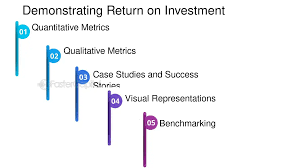
- Case studies
- Customer testimonials
- Pilot results
- Benchmarks
- Industry research
Evidence transforms value propositions from promises into proof.
Keep Evidence Relevant
Choose examples that closely match the audience’s industry, size, or situation to maximise credibility.
Step 10: Communicate Value Consistently Across Channels
Inconsistent messaging creates confusion and weakens trust.
Align Marketing, Sales, and Product Messaging
Ensure that:
- Marketing materials
- Sales conversations
- Presentations
- Proposals
all reinforce the same core value proposition and ROI narrative.
Avoid Mixed Messages
If different teams communicate different value points, audiences may question clarity and reliability.
Step 11: Use Clear Visuals and Structure
Presentation matters as much as content.
Simplifying Complex Information
Charts, tables, and diagrams can help explain ROI and value more efficiently than text alone.
Prioritising Readability
Use:
- Clear headings
- Logical flow
- Short paragraphs
This improves comprehension and retention.
Step 12: Address Objections Proactively
Anticipating concerns strengthens credibility.
Common Objections
- “This seems expensive”
- “The benefits are uncertain”
- “Implementation looks complex”
Addressing these points directly shows confidence and preparedness.
Reframing Cost as Investment
Shift the conversation from cost to value over time. This helps audiences evaluate decisions more strategically.
Step 13: Adapt Communication for Long-Term Relationships
Value communication does not end after a decision is made.
Reinforcing Value Over Time
Regularly revisit:
- Achieved results
- Ongoing benefits
- Opportunities for improvement
This reinforces trust and supports retention.
Measuring and Reporting Outcomes
Sharing progress against expected ROI strengthens relationships and credibility.
Common Mistakes to Avoid When Communicating Value and ROI
- Being too vague or generic
- Overloading with data without context
- Focusing only on features
- Making unrealistic claims
- Ignoring the audience’s priorities
Avoiding these mistakes improves clarity and effectiveness.
The Role of Storytelling in Value Communication
Stories make value relatable.
Turning Data into Narrative
Combine numbers with stories that show:
- The problem before
- The change achieved
- The outcome realised
Stories help audiences remember and internalise value.
Final Thoughts: Communicating Value and ROI with Confidence and Clarity
Communicating value proposition and return on investment is not about persuasion alone—it is about clarity, relevance, and trust. When done well, it helps audiences make informed decisions and positions your offering as a meaningful solution rather than just another option.
The most effective communicators:
- Understand their audience deeply
- Focus on outcomes, not features
- Balance qualitative and quantitative value
- Use evidence and realism
- Communicate consistently and transparently
By adopting a structured, customer-focused approach, you can ensure that your value proposition is clearly understood and your ROI is seen as credible and compelling. In a crowded and competitive landscape, this clarity can make the difference between being overlooked and being chosen.
Summary:
As part of my continuing series on Value and Pricing, the following article shows you how to position your company’s value contribution to support the highest value-for-value exchange.
Too many business owners, when asked about the value or ROI of their product or service, shrug their shoulders and say, “I can’t really put a value on it.” If you can’t put a value on it, think how hard it is for your prospects and customers! And if they can’t put a value on it, how likely i…
Keywords:
Advisory Boards, Strategy, Growth Strategies, Strategic Planning, Executive Coaching, Valuation,
Article Body:
As part of my continuing series on Value and Pricing, the following article shows you how to position your company’s value contribution to support the highest value-for-value exchange.
Too many business owners, when asked about the value or ROI of their product or service, shrug their shoulders and say, “I can’t really put a value on it.” If you can’t put a value on it, think how hard it is for your prospects and customers! And if they can’t put a value on it, how likely is it for them to buy it?
We’re going to give you a simple way to identify all the value elements of your product or service and articulate it in such a way that your customers will absolutely know in quantifiable terms what your value is to them. They will see so much ROI they’ll be foolish not to want to buy from you.
The key idea here is that you communicate Return on Investment by looking at your value proposition through your customers’ eyes. In other words, why should they spend their scarce money with you, versus using the funds in some other way?
Your customers want to know how long it will take them to get back their investment or make a profit. Many will want to see a recurring return.
There’s an old marketing saying: “Make your product free”. People will pay more when they think that “it doesn’t cost them anything.” You do this by building so much intrinsic value into your offering that it far exceeds the cost to the customer; do this correctly and in their perception, it’s free.
Creating Value with Your Product or Service:
First, list all the ways that you create value for your customers.
Does your product or service…
–Help client’s increase their revenues? Does your product/service increase their sales? Create more leads? Increase their competitiveness in their market? Shorten the sales cycle? Get more repeat and referral business?
–Allow them to raise prices, or at least hold prices level? Does the value you create allow your customer to charge higher prices for their offering?
–Reduce expenses? Does it reduce initial or ongoing cost? Does it reduce overhead such as utilities and rent or carrying charges? Does it save money on materials, equipment, staff, and outside services? Does it provide a more economical installation or a longer life span? Does it reduce error rate?
–Allow them to replace some existing expense at a lower cost?
–Enable staff headcount reductions? Does it allow your customer to make headcount reductions in staff or support personnel?
–Avoid impending or predicable expenses? Does it help avoid expenses altogether?
–Increase their products’ and services’ perceived value. Does it increase the perceived value of your customer’s offering?
–Increase productivity? Does it increase your customer’s productivity or the productivity of his staff? Does it increase manufacturing production or throughput?
–Give them greater control? Does it offer some way for your customer to track results, lead generation, sales, profitability, productivity, or any other key success factor?
Next, review the list and for each of the ways you create value, figure what each is worth. This could be in terms of absolute amounts of money, some percentage of revenues, or some percentage of expense reduction.
Create proof for each of your value assertions. Proof can be in the form of worksheets, testimonials, case studies, success stories, printed statements, even survey results.
Add up each of the value elements to come up with a total value, combining earnings and savings into one number. Again, the total value can be an absolute money number, such as $645,000, or it can be a percentage of sales.
Lastly, calculate your return on investment by comparing the total value to the cost of your product. You may come up with either an ROI (return on investment) or a “payback period.” Either way, you’ve quantified your product’s value in concrete terms, justified your price, and made it far, far easier for your prospects to make a buying decision.
Success Story
One of our clients sells enterprise software in the $150,000 to $250,000 zone. After 9/11, their sales cycle began to get longer and longer and stretched out as much as eighteen months, with most prospective deals ending in “no decision.” Prospects knew they needed to replace their old software, but they simply couldn’t justify the expense in a no-growth economic climate.
To accelerate the sales process we implemented a return on investment analysis using the exact steps described above.
First we itemized each of the ways the software saved or earned the client money, including replacing old software with a high maintenance cost, reducing the cost of computer leases, reducing materials waste, decreasing the number of customer service staff required, shortening their salesman’s phone time, increasing the accuracy of sales quotes, thereby increasing the prospect’s sales AND increasing overall sales profitability.
By assigning a dollar value to each value element, and offering proof for each one, our client was able to demonstrate a payback period of around 9 months, and a significant positive return on investment thereafter.
The first two prospects who heard this value presentation said the same thing: “We’d be fools not to buy this,” resulting in the two shortest sales cycles, and coincidentally, the two largest individual sales in the company’s history.

Tinggalkan Balasan